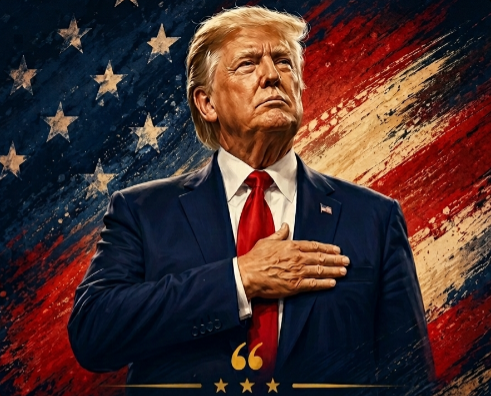
President Donald Trump has reignited a major national debate after invoking religious authority while discussing American sovereignty, individual liberty, and the limits of government power.
In his statement, Trump framed American independence through explicitly religious language, emphasizing the idea that citizens’ ultimate allegiance belongs to God rather than government institutions. The message presents faith as a foundational principle behind American freedom and national sovereignty.
Trump’s supporters are praising the statement as a powerful defense of traditional American values. They argue that individual rights are not gifts from government but come from a higher authority, and they see Trump’s words as a response to what they consider growing government overreach and increasing pressure on religious expression in public life.
But critics are raising serious concerns about the political implications of the message. They argue that government officials invoking divine authority can blur the line between religious belief and constitutional governance. They also warn that such language could make secular Americans and people from non-Christian religious traditions feel excluded from the broader definition of American identity.
At the heart of the controversy is a much larger question: What should define America—religious faith, constitutional principles, or a combination of both?
The United States was founded on principles of individual liberty, freedom of religion, and limits on government power. Yet Americans have long debated how religious beliefs should influence political leadership and public policy.
Trump’s statement has brought that debate back into the national spotlight, with supporters describing it as a defense of America’s spiritual foundation while opponents see it as a potentially divisive use of religion in politics.
The disagreement goes beyond one presidential statement. It touches on some of the country’s deepest questions about freedom, faith, citizenship, government authority, and the meaning of American sovereignty.
As political divisions continue to intensify, Trump’s religious framing is likely to fuel both passionate support and strong opposition.
The question now facing America is not simply what Trump said—but what kind of nation Americans believe the United States should be: one guided primarily by religious conviction, constitutional principles, or a careful balance between the two.